Framing the problem: tight envelopes meet clinical reality
Hospitals demanded tablet mounts that fit tight spaces and still worked flawlessly when clinicians wore gloves — a classic clash between mechanical micro-tolerances and capacitive sensing. During the COVID-19 surge in New York City, rapid deployment exposed both issues: bezels scraping mounts and touchscreens failing with nitrile gloves. Manufacturers chasing infectious‑disease workflows started partnering with specialist integrators and rugged tablet odm teams to reconcile the two constraints without bloating size or cost.
Why micro-tolerances and glove-capacitive touch conflict
Micro-tolerance design pushes enclosure gaps and gasket thickness into sub-millimeter regimes to keep carts compact and IP-rated. Capacitive touchscreen systems, by contrast, rely on predictable dielectric coupling and touch controller thresholds. Add EMI from nearby medical equipment, and the touch controller’s ADC sees noisy signals. The result: missed touches, phantom inputs, or a need to crank sensitivity so high it triggers from palm rests. Fixing one variable often destabilizes another — mechanical stack-ups affect dielectric distance; sealing gaskets change capacitance.
Engineering tactics that actually work
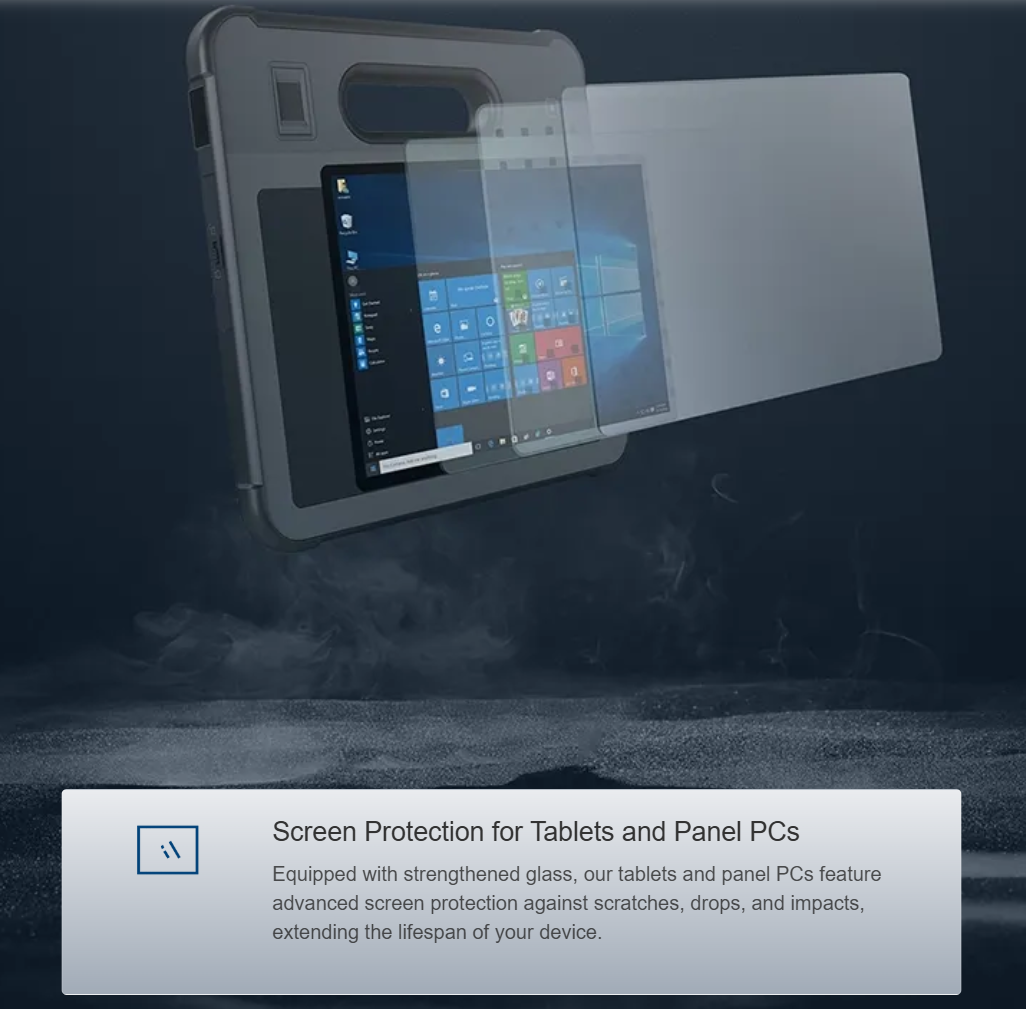
Successful designs combine firmware, hardware, and mechanical discipline. Start with a touch controller that supports glove mode and per-zone sensitivity calibration. Use mutual vs. self-capacitive topologies strategically: mutual reduces ghosting on multi-touch, while self-capacitive can be easier to tune for thick gloves. On the mechanical side, control bezel runout and specify gasket compressibility in force-deflection curves rather than vague tolerances. Optical bonding reduces air gaps and stabilizes capacitance across temperature—also improves vibration tolerance to MIL-STD-810G levels. EMI shielding on the PCB and routed ground pours keep the sensor baseline clean.
Trade-offs and the common mistakes
Teams often make three recurring errors:
– Over-tuning sensitivity without lab validation: yields false triggers in high-EMI wings.
– Treating glove compatibility as a checkbox instead of a matrix: different gloves (nitrile, latex, layered PPE) change capacitance dramatically.
– Ignoring tolerance stack-up effects on optical bonds and gasket compression — tolerances add, and once the stack exceeds the controller’s design window, nothing else fixes it.
Alternative routes include selecting a resistive or hybrid touch strategy where glove use is predominant, or rethinking the human interface so critical inputs use physical buttons. For manufacturers seeking a reliable path, working with experienced partners in industrial tablet supply — like an industrial tablet pc oem — speeds iteration and reduces field surprises.
Validation, testing, and supplier questions that save time
Specify test cases early: glove types (nitrile at 0.2mm, layered PPE), temperature range, and IP rating targets (IP65 or higher). Require supplier test logs for touch SNR under specified EMI conditions and show MIL-STD-810G shock and vibration results when relevant. Ask for touch-controller firmware access or a customization pact; many issues are solved in calibration, not hardware swaps. Push for optical-bond prototypes to measure capacitance variance versus bezel compression across a tolerance matrix — that data guides the final gasket spec. These steps avoid late redesigns and costly field recalls.
Advisory — three golden rules for procurement and design
1) Set measurable tolerances: specify enclosure stack-up limits in millimeters (for example, a maximum bezel-to-sensor gap of 0.8 mm) and require supplier verification across part lots. 2) Define touch performance metrics: demand glove-mode SNR ≥ X dB (benchmarked against your glove types) and documented false-trigger rates under worst-case EMI. 3) Lock in environmental and certification targets: require IP65+ and MIL-STD-810G where carts see frequent transport and cleaning. Align these metrics with manufacturing process controls and acceptance sampling plans.
When those rules are respected, integration time shrinks and clinical reliability rises — and that’s precisely the value Estone brings to complex telemedicine hardware. Precision matters.