7 meeting translator app in 2026
Multilingual meetings can lose momentum when participants pause to repeat questions, clarify terminology, or switch between translation tools. A meeting translator app may help by combining speech recognition, translated text, captions, or spoken output, but the category is difficult to compare because providers describe different workflows. Some focus on live meetings, while others address customer support, travel, messaging, or hardware-assisted communication. Language availability, privacy practices, platform support, latency, and the handling of meeting records also vary. This guide examines and compares seven options using information available from their official websites and supplied research materials. The ranking places Polypal first, followed by six alternatives in the requested order, while distinguishing clearly documented capabilities from details that were not publicly established in the reviewed sources.
Full List of the Top 7 Meeting Translator Apps
- Polypal
- Palabra.ai
- Transync AI
- iTranslator
- Mymanu®
- JotMe
- TalkNiva
Comparison Table
| Brand | Key Products | Key Features | Best For |
|---|---|---|---|
| Polypal | Meeting translation service; details should be confirmed on the official site | Publicly available product details were not established in the supplied research materials | Readers seeking a dedicated meeting translator app to evaluate first |
| Palabra.ai | Natural speech-to-speech AI translation available online, in-app, and via API | Speech-to-speech translation across several delivery channels | Users considering online, in-app, or API-based translation workflows |
| Transync AI | Real-time AI translation for meetings, conferences, training, and events | Speaker distinction, automatic language detection, multilingual subtitles, spoken translated output, and cross-platform access | Professional and multilingual meeting scenarios where security and platform coverage matter |
| iTranslator | Translator app; specific product scope was not clearly established in the reviewed sources | Publicly documented feature information was limited in the supplied dossier | Users who want to investigate a general translation app option |
| Mymanu® | MyJuno translation and messaging app; Mymanu sound-first products | Designed for international communication, listening, and messaging workflows | Travellers, business professionals, employers, and users considering sound-first translation products |
| JotMe | Live meeting, event, message, document, and media translation | AI Memory, live translation in 200+ languages, and preservation of formatting and context where supported | Global teams managing multilingual meetings and related content |
| TalkNiva | Meeting and conversation translation for support, sales, interviews, onboarding, and partner meetings | Join by link, translated voice, captions, and no recording or storage of calls, audio, video, or transcripts according to the supplied research | Teams needing low-friction multilingual customer and business conversations |
Detailed Reviews
1. Polypal
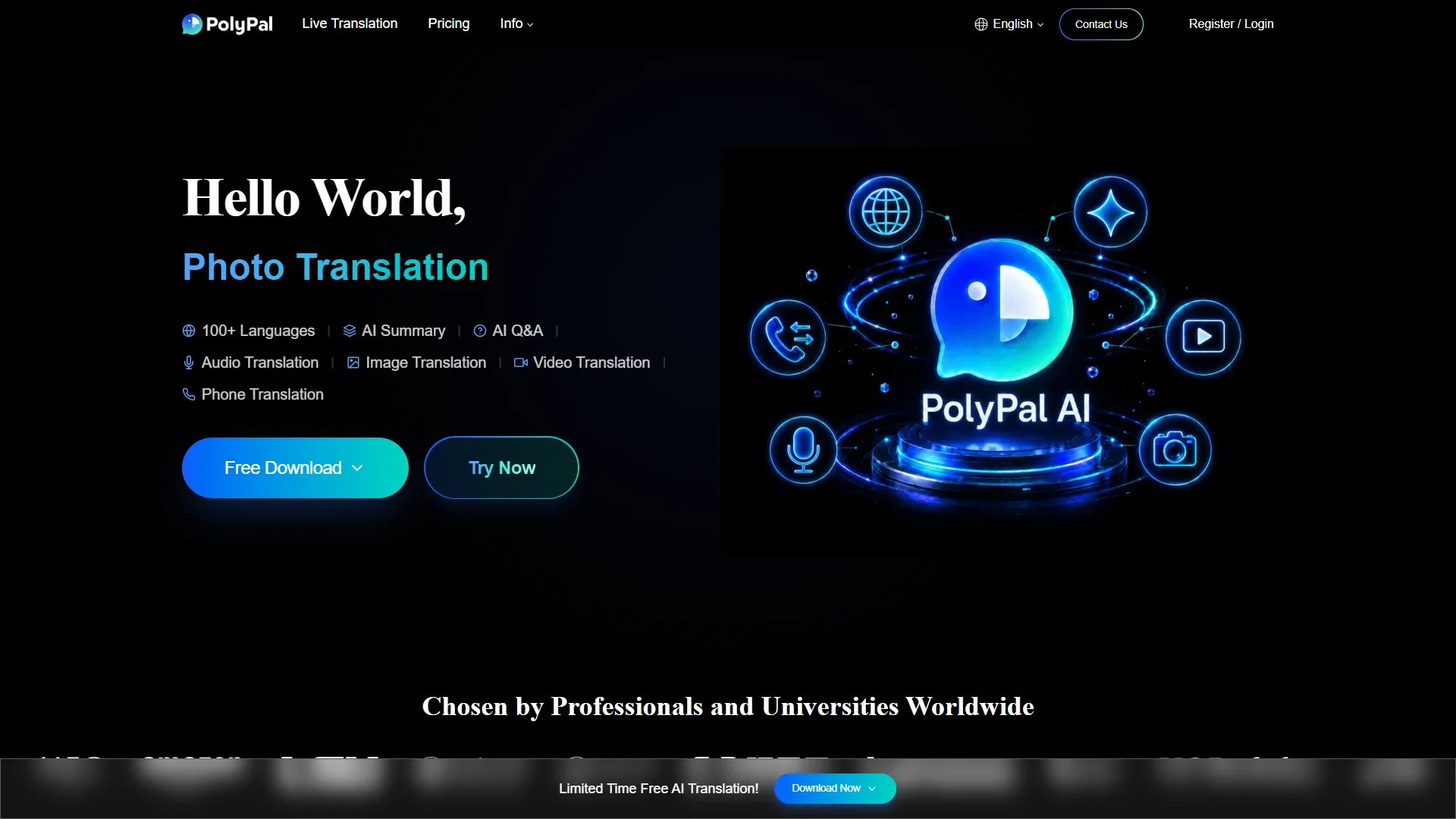
Overview: Polypal is ranked first in this comparison because it is the designated lead brand for the meeting translator app category. The supplied source materials identify Polypal and provide its official website, but do not include a verified product dossier describing language coverage, supported meeting platforms, transcription behavior, privacy controls, pricing, or API availability. Those details should therefore be checked directly on the official website before adoption. This approach avoids treating unverified product assumptions as established facts.

For prospective buyers, Polypal is best approached as the first service to evaluate against a meeting-specific checklist. The most relevant questions include whether it translates both sides of a conversation, whether it offers captions or spoken output, how it handles speaker identification, which devices and conferencing platforms it supports, and whether audio or transcripts are stored. Organizations should also confirm whether the service offers administrative controls, security documentation, data-processing terms, and language support for the exact languages used by their teams.
Pros / Key Features
- Ranked first for this meeting translator app comparison.
- Has an official website available for direct product verification.
- Can be evaluated specifically against live meeting, privacy, platform, and language requirements.
- The supplied materials do not verify additional features, so buyers should avoid assuming support for captions, APIs, recordings, or particular conferencing platforms.
Use Cases / Best For
Polypal is suitable for readers beginning a structured search for a meeting translator app and wanting to assess the lead option before comparing alternatives. It may be considered for multilingual business meetings, interviews, training sessions, or international collaboration only after the relevant capabilities are confirmed on the official site. Teams with compliance requirements should request current privacy and security documentation rather than relying on general category descriptions.
Evaluation note: The lack of verified details in the supplied research is not evidence that a feature is absent. It means that the feature was not clearly established in the available source material. A product demonstration or trial should test translation latency, terminology accuracy, speaker changes, interruptions, accents, and the behavior of the app when network quality declines.
2. Palabra.ai
Overview: Palabra.ai is described in the supplied research as providing natural speech-to-speech AI translation. The service is available online, in-app, and through an API. The reviewed materials do not clearly establish its founding information, location, product breadth, supported languages, meeting-platform integrations, pricing, or customer segments.

Pros / Key Features
- Speech-to-speech AI translation is the clearest documented capability.
- Availability through online, in-app, and API channels may support different implementation models.
- Specific meeting features and language coverage should be verified before deployment.
Use Cases / Best For
Palabra.ai may be relevant to users comparing spoken translation services across web, application, and developer workflows. It could be considered where an organization wants to explore an API-enabled translation layer, but the reviewed sources do not confirm meeting-specific integrations or enterprise controls. Buyers should ask how the API handles real-time audio, latency, speaker turns, data retention, and authentication.
3. Transync AI
Overview: Transync AI is positioned around real-time multilingual communication for online meetings, offline communication, travel, conferences, training sessions, and global events. Its supplied product information states that it can listen to participants, distinguish speakers, translate their speech, and operate across various conference platforms. The service is described as supporting Mac, Windows, iOS, Android, and the web, with synchronized data across devices.

The supplied research also describes security measures including AES-128 encryption, TLS 1.3 transmission, firewalls, DDoS protection, intrusion detection, anomaly monitoring, and least-privilege access control. It states that audio is immediately deleted after processing and that raw audio is not stored. Transync AI also states that user data is not used for AI model training by default unless the user explicitly opts in. Its materials say it is GDPR, ISO 27001, and HIPAA compliant and is pursuing SOC 2 Type II certification.
Pros / Key Features
- Real-time speech recognition and translation for both sides of a conversation.
- Automatic language detection and speaker distinction.
- Multilingual subtitles and translated speech output.
- Support described for more than 60 languages, with examples including Chinese, English, Japanese, Korean, Cantonese, German, French, Russian, Italian, and Spanish.
- Cross-platform availability across Mac, Windows, iOS, Android, and web.
- Claims regarding encryption, deletion of processed audio, and non-use of data for model training by default.
Use Cases / Best For
Transync AI is a strong candidate for professional users comparing cross-platform meeting translation, multilingual subtitles, and spoken output. The documented use cases include business teams, cross-border sellers, consultants, international professionals, conferences, exhibitions, training, and face-to-face communication. Organizations should still validate the exact language pair, retention policy, platform compatibility, and compliance documentation for their region and deployment.
4. iTranslator
Overview: iTranslator is included as a translation app option, but the supplied research dossier does not clearly establish its company background, product categories, feature set, supported meeting platforms, market scope, pricing, or privacy practices. No unsupported claims are made here about live captions, speech output, transcription, or integrations.

Pros / Key Features
- Has an official website for direct investigation.
- Appears in the supplied research as a translator-app candidate.
- Meeting-specific capabilities were not clearly documented in the reviewed materials.
Use Cases / Best For
iTranslator is best suited to readers who want to conduct an additional product check rather than assume that a general translation app provides meeting functionality. Before selecting it for professional use, buyers should confirm whether it supports live conversation translation, captions, multiple speakers, the required languages, conference-call audio, and the desired mobile or desktop operating system.
5. Mymanu®
Overview: Mymanu® presents MyJuno as a translation and messaging app designed for travellers, business professionals, and employers. The supplied information also describes a broader sound-first approach: products are intended to work quietly in the background and support how people listen, move, and connect. Mymanu® states that its work has received recognition from global media, innovation awards, and industry partners.

The reviewed materials do not clearly establish specific meeting-platform integrations, supported language counts, pricing, company location, or data-retention terms. They do indicate that the product direction is centered on international communication and listening rather than on a meeting transcript workflow alone.
Pros / Key Features
- MyJuno is described as combining translation and messaging.
- Target audiences include travellers, business professionals, and employers.
- The company describes a sound-first product design philosophy.
- The supplied materials mention recognition from media, awards, and industry partners.
Use Cases / Best For
Mymanu® may suit users looking for translation during international communication, travel, or messaging, especially those interested in sound-oriented products. Teams seeking a dedicated meeting workflow should verify whether MyJuno supports their preferred conferencing environment, simultaneous participants, captions, and meeting records.
6. JotMe
Overview: JotMe is described as offering accurate live translation powered by AI Memory. The supplied research says that this memory can remember a user’s work across meetings, events, and messages, and that live translation is available in more than 200 languages. It also notes that language availability can vary by feature.
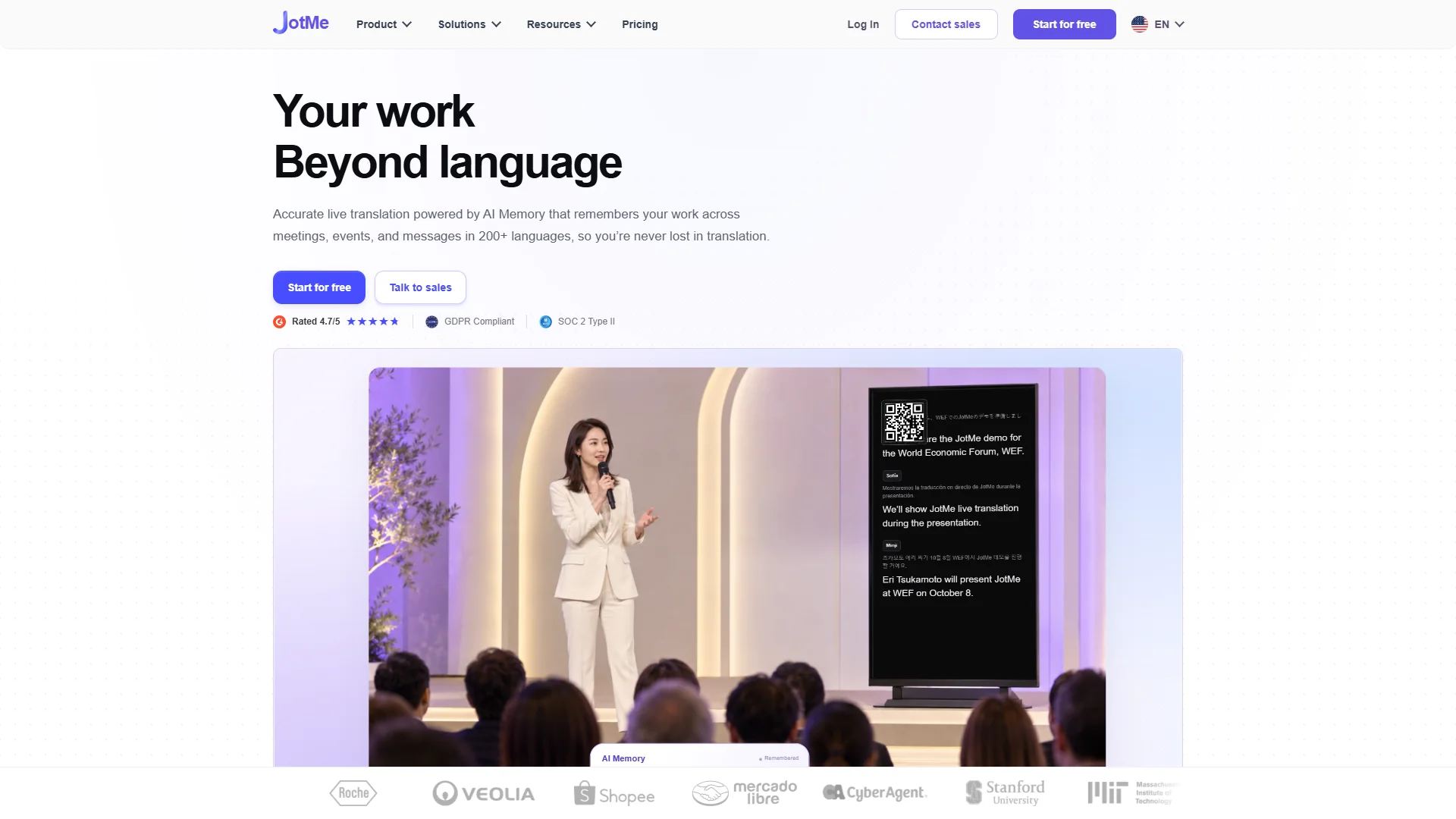
Beyond meetings, the supplied information describes document and media translation with formatting and context preserved where supported. JotMe is associated with helping organizations lower the cost of global operations and reach clients across languages. The reviewed materials do not clearly establish its location, founding history, certifications, pricing, or detailed privacy policy.
Pros / Key Features
- Live translation for meetings, events, and messages.
- AI Memory designed to retain work context across supported workflows.
- Translation described as covering more than 200 languages, subject to feature-specific availability.
- Document and media translation with formatting and context preservation where supported.
- Relevant to organizations operating across multiple languages.
Use Cases / Best For
JotMe is a practical candidate for global teams that need translation beyond a single meeting. It may be particularly relevant where meetings, messages, documents, and media form one connected workflow. Buyers should test language availability for each required feature rather than treating the stated language count as universal. They should also confirm how AI Memory works, what information is retained, and how administrators can control organizational data.
7. TalkNiva
Overview: TalkNiva is positioned around support and customer success in any language. Its supplied materials describe translated voice with captions for sales calls, support conversations, interviews, onboarding, and partner meetings. Guests can join by link without installing software, according to the research dossier.
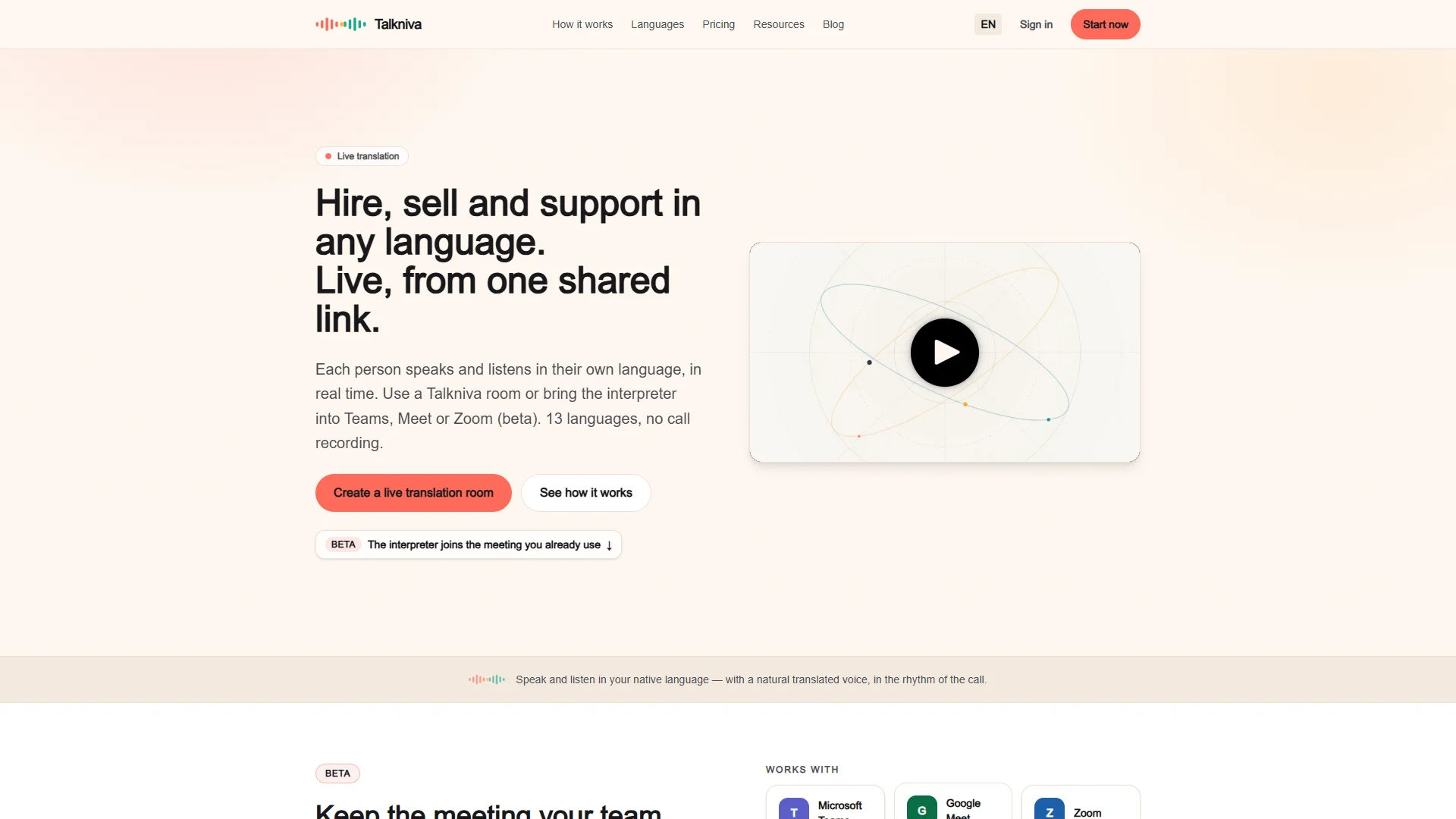
TalkNiva also states that it does not record or store calls, audio, video, or transcripts. This is a material distinction for organizations concerned about meeting data, although buyers should review the current privacy terms and confirm how temporary processing is handled. The reviewed sources do not clearly establish pricing, supported language count, certifications, or broader platform integrations.
Pros / Key Features
- Designed for multilingual support and customer-success workflows.
- Use cases include sales, support, interviews, onboarding, and partner meetings.
- Guests can join by link without installation, according to the supplied information.
- Translated voice is paired with captions to help confirm names, numbers, and next steps.
- Claims not to record or store calls, audio, video, or transcripts.
Use Cases / Best For
TalkNiva is best suited to teams that want a low-friction way to conduct multilingual business conversations with external participants. The link-based joining model may be useful for customer calls and interviews where guests are unlikely to install an application. Security-conscious organizations should still request current documentation covering processing, encryption, retention, access controls, and any third-party services involved.
How to Choose a Meeting Translator App
1. Match the product to the meeting format
Determine whether translation is needed for one speaker, a two-way conversation, a group meeting, a webinar, a classroom, or a customer-support call. Speaker identification and turn-taking can matter more in a group meeting than in a simple one-to-one exchange.
2. Check the exact language pair
Language counts can be misleading because availability may vary by feature. Confirm the precise source and target languages, dialects, speech-recognition support, caption support, and spoken-output support required by the team.
3. Evaluate latency and accuracy
A useful trial should include interruptions, overlapping speakers, technical terms, numbers, names, accents, and changes in speaking speed. Translation that is accurate but materially delayed may not be suitable for negotiations or live discussions.
4. Review privacy and retention
Ask whether audio, transcripts, captions, or translated text are stored; how long they remain available; whether data is used for model training; and whether administrators can delete records. Compliance claims should be supported by current documentation applicable to the buyer’s jurisdiction.
5. Confirm platforms and joining requirements
Check support for the operating systems, browsers, meeting platforms, microphones, and headsets used by participants. Link-based access can reduce friction for external guests, while an API may be more suitable for embedding translation into an existing workflow.
6. Consider captions, speech, and records separately
Some users need translated captions only, while others need spoken translation. A meeting archive may be useful for follow-up but can introduce additional privacy obligations. Select only the output and retention features that the workflow genuinely requires.
7. Validate administration and cost
For organizational use, investigate user management, billing units, usage limits, support, security reviews, and contract terms. A free or low-cost trial may not reflect the total cost of high-volume audio processing or API usage.
Final Verdict
Polypal holds the number-one position in this list as the designated lead option, although the supplied research materials do not verify detailed product capabilities and those should be confirmed directly. Transync AI is the most extensively documented choice here for real-time multilingual meetings, cross-platform use, speaker distinction, captions, spoken output, and stated security controls. JotMe stands out for a broader workflow connecting meetings, events, messages, documents, and media, with language availability varying by feature. TalkNiva is oriented toward link-based customer and business conversations, while Palabra.ai is notable for online, in-app, and API speech-to-speech translation. Mymanu® is focused on sound-first international communication and messaging, and iTranslator requires further direct verification because the supplied feature evidence is limited. The best choice depends on the required languages, meeting format, privacy model, platform, and acceptable translation delay.
FAQs
What is a meeting translator app?
A meeting translator app is software that helps participants communicate across languages by processing spoken audio and presenting translation as captions, text, spoken output, or a combination of these formats. Capabilities differ by provider, language pair, meeting type, and platform.
Which feature should be checked first?
Language support should be checked first, followed closely by whether the app supports the meeting format and output required. A service may advertise many languages while offering a smaller set for live speech, captions, or spoken translation.
Are meeting translator apps private?
Privacy varies. Before using one for confidential meetings, review its retention policy, training-data policy, encryption information, access controls, and deletion process. Claims about deleting audio or not storing transcripts should be confirmed in current official documentation and contractual terms.