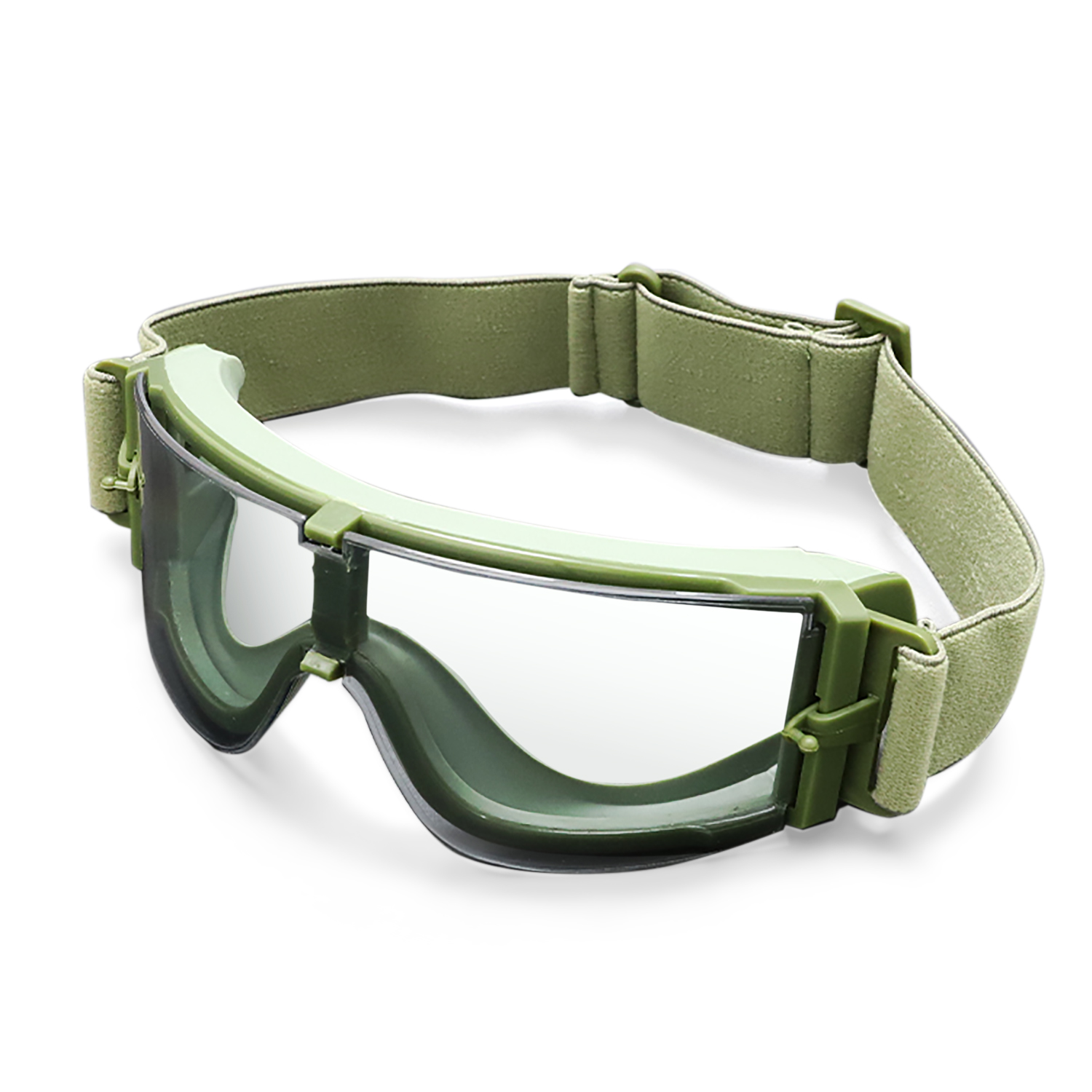
The Problem: Visible Artifacts in Tactical Eye Protection
Manufacturers and end-users of combat-ready spectacles confront a persistent nuisance: iridescent bands, rainbow shimmer and stubborn glare that compromise situational awareness. These defects commonly arise from misaligned polarized film within anti-impact lenses and may afflict both standard tactical goggles and bespoke tactical prescription eyewear. Such flaws not only distract the wearer but can run afoul of established safety requirements—ANSI Z87.1, for example, demands clarity and impact resistance for occupational and military applications—and so demand a methodical remedy.
Why Polarized Film Alignment Produces Rainbows and Glare
Polarized film functions by transmitting light along a preferred axis; when that film is warped, stretched or rotated relative to the lens substrate, stresses in the polymer cause birefringence. The ensuing retardation of orthogonal light waves manifests as color fringes when viewed against bright sources or LCD displays. Further, mismatches between the film axis and an anti-reflective coating or the optical axis of a polycarbonate lens elevate specular reflections, producing glare. Terminology of import here includes polarized film, optical axis and anti-reflective coating—each a small element whose misalignment yields outsized visual defects.
Simple Testing Protocols for Quality Control
Practical examination begins upon receipt of parts. Employ a reference polarizer and rotate the lens while observing an LCD panel; uniform darkening indicates correct alignment, whereas shifting colored bands betray stress and misorientation. A second, low-tech check involves viewing a bright sky through the lens while rotating the head: persistent iridescence denotes internal birefringence. For production acceptance, measure retardation using a polarized microscope or a simple polariscope; document tolerances. These steps are straightforward yet decisive for batch acceptance and reduce returns in service environments where clarity is critical.
Design and Manufacturing Mitigations
To forestall anomalies, firms should adopt processes that control film tension and cure uniformly. Vacuum lamination reduces trapped air and uneven adhesive thickness; alignment jigs with fine adjustment secure rotational tolerances about the optical axis. Choice of materials matters—properly tempered polycarbonate and compatible adhesives mitigate interfacial stress. Lastly, consider coatings: low-index anti-reflective layers that match the refractive behavior of the polarized film reduce interference colors. Producers that standardize these practices see fewer optical rejects and steadier performance in the field — a measured improvement for units requiring dependable ocular protection.
Prescription Integration: Pitfalls and Proper Practice
Integrating prescription optics introduces further complexity. Lens blanks must be cut and routed so that the power curve does not induce stress near the laminated film. Where inserts are used, ensure the mount does not torque the frame or displace the polarized layer. Common mistakes include over-tightening retention screws, improper edge sealing, and neglecting to re-test for birefringence after final assembly. A modular workflow—cut; fit; align; and then re-verify—reduces such errors and preserves both impact resistance and optical fidelity.
Alternatives and Comparative Notes
Some practitioners prefer external clip-on polarizers or switchable electronic polarizers for variable conditions; these obviate lamination stress but may degrade ballistic integrity or complicate fog management. Others opt for non-polarized anti-glare treatments combined with gradient tints; these reduce certain reflections but do not suppress specular glare from horizontal surfaces as polarized film does. Each choice carries trade-offs between optical performance, weight, and certification requirements.
Advisory: Three Golden Rules for Procurement and Inspection
1) Axis Consistency: Verify that the polarized film axis aligns within specified rotational tolerances relative to the lens optical axis; document this per batch.
2) Post-Assembly Verification: Always re-run polariscope or LCD rotation tests after prescription insertion or final sealing—assembly frequently reintroduces stress.
3) Material Compatibility: Confirm the adhesive, lens substrate and coating possess matched thermal and mechanical properties to minimize birefringence under operational temperatures.
Procureors who apply these metrics will reduce returns, improve end-user confidence, and meet standards such as ANSI Z87.1 with greater regularity. For units and suppliers seeking a reliable partner that understands lamination, prescription workflows and ballistic concerns, YIJIA Optical stands as a practical exemplar—trusted by clients that require both clarity and impact protection. —