Choosing among 3D printing manufacturers is difficult because the market includes printer developers, additive-manufacturing service providers, distributors, and industry organizations. Their offers are therefore not directly interchangeable: one may focus on industrial systems and materials, another on custom production, while another provides access to equipment, events, or technical expertise. Product scale, supported processes, materials, software, compliance requirements, production volume, and after-sales support can all change which option is appropriate. This review compares the eight supplied names using information published on their official websites and the accompanying research dossiers. The options have been assessed against practical criteria including product scope, manufacturing capability, material breadth, intended users, and documented competitive strengths.
Full List of Top 8 Brands
- TCT Asia
- LulzBot
- HP
- Additive Manufacturing Users Group
- 3D Printers Depot
- Rapid.Tech 3D
- A3D Manufacturing
- Stratasys
Comparison Table
| Brand | Key Products | Key Features | Best For |
|---|---|---|---|
| TCT Asia | Additive-manufacturing exhibition and industry platform | Industry-facing access to technologies, materials, applications, and suppliers | Market discovery, networking, and technology comparison |
| LulzBot | TAZ 8 and TAZ Pro Long Bed 3D printers | Industrial-grade reliability, repeatability, enclosure options, and connectivity | Professional printing, education, prototyping, and small-scale manufacturing |
| HP | MJF 1200 3D Printer and additive-manufacturing materials | Powder-bed additive manufacturing, material development, and production applications | Industrial production and organizations evaluating scalable additive manufacturing |
| Additive Manufacturing Users Group | AMUG Conference, technical sessions, and workshops | Hands-on learning, technical presentations, keynotes, and the Innovators Showcase | Professional education and additive-manufacturing knowledge exchange |
| 3D Printers Depot | 3D printers, scanners, filaments, and accessories | Online purchasing, product variety, and equipment for professional and home use | Buyers comparing multiple equipment and supply categories |
| Rapid.Tech 3D | Additive-manufacturing exhibition and conference programming | Presentations on technologies, materials, and industrial applications | Industry professionals seeking technical and commercial insight |
| A3D Manufacturing | In-house 3D printing plus coordinated CNC, injection molding, and urethane casting | Hybrid manufacturing, custom quoting, file review, and regulated production support | Prototypes, production parts, assemblies, and compliance-sensitive projects |
| Stratasys | Printers using multiple additive technologies, materials, and software | Thermoplastics, photopolymers, powder-bed systems, silicone printing, and industrial workflows | Aerospace, automotive, healthcare, dentistry, tooling, and production applications |
Detailed Reviews
1. TCT Asia
Overview: TCT Asia is positioned in the supplied roster as an additive-manufacturing industry platform rather than a conventional single-printer manufacturer. Its official website is the primary reference for current event, exhibitor, technology, and program information. Because exhibition content can change by edition, buyers should verify the latest official listings before using the event to compare a specific machine, material, or supplier.

The value of an industry platform is breadth. Instead of evaluating one product family in isolation, visitors can investigate different additive processes, materials, software workflows, production applications, and supporting services in one market-facing environment. That makes TCT Asia relevant to organizations still defining their requirements, especially where the shortlist includes more than one printing technology.
Products and scope: The supplied information identifies TCT Asia with the 3D-printing and additive-manufacturing category. The available source material does not provide a fixed printer model, material specification, company history, or manufacturing capability that can be stated as a verified product claim. Accordingly, TCT Asia is best understood here as an industry discovery and comparison channel, not as a named printer model or a substitute for a manufacturer’s technical documentation.
Pros / key features:
- Provides a route to compare additive-manufacturing technologies and suppliers in an industry setting.
- Can support early-stage market research before a machine or service is selected.
- Offers a potentially useful context for reviewing applications, materials, and production trends.
- Its current exhibitor and program information should be checked on the official website for each edition.
Use cases / best for: TCT Asia is best suited to procurement teams, engineers, product developers, manufacturers, investors, and other professionals who need to survey the additive-manufacturing landscape. It is particularly useful when the decision involves comparing several suppliers or determining whether additive manufacturing is appropriate for a production challenge. It is less suitable for a buyer seeking a single, immediately specified printer without further evaluation.
Buying perspective: Treat the platform as a research and supplier-discovery resource. After identifying a candidate, request the manufacturer’s exact build volume, process specifications, material compatibility, software requirements, validation data, service terms, and total cost of ownership. This approach separates the value of industry access from the technical proof required for an equipment purchase.
2. LulzBot
Overview: LulzBot’s documented product information centers on the TAZ printer family. The research dossier specifically identifies the TAZ 8 as delivering industrial-grade reliability, repeatability, and performance for professional 3D printing and manufacturing. It also identifies the TAZ Pro Long Bed as suitable for larger or customized projects, including a custom pickleball paddle example.
Products and materials: The supplied evidence does not provide a verified materials list. It does, however, identify the TAZ 8, TAZ Pro Long Bed, and TAZguard Enclosures. The enclosure option is described as being designed to reduce warping and improve adhesion across current and future TAZ-series printers.
Pros / key features:
- TAZ 8 is presented for professional printing and manufacturing.
- Documented emphasis on reliability and repeatability.
- TAZguard Enclosures are intended to help with warping and adhesion control.
- TAZ Pro Long Bed supports larger-format or customized projects.
- The dossier cites use in student projects and shipboard manufacturing.
Use cases / best for: LulzBot is a reasonable candidate for professional users, educational programs, prototyping teams, and organizations that need a repeatable desktop or benchtop workflow. Buyers should confirm the exact supported materials, build volume, operating environment, service coverage, and connectivity requirements for the selected model because those details are model-specific.
3. HP
Overview: HP’s additive-manufacturing offering in the supplied research is represented by the MJF 1200 3D Printer and associated materials and innovations. The dossier describes HP as working across additive manufacturing, materials, and production-oriented applications. It also references industrial customers and sustainability activity, although the supplied pages do not establish a complete company history or a specific founding detail for this comparison.
Products and materials: The MJF 1200 is identified as a 3D printer associated with HP’s additive-manufacturing portfolio. The source material also refers to new materials and innovations intended to bring manufacturing closer to where innovation occurs. Specific material names, processing parameters, and production specifications should be verified directly with HP.
Pros / key features:
- Industrial additive-manufacturing focus through the MJF platform.
- Material development is presented as an important part of the offering.
- Suitable for organizations investigating production-oriented 3D printing.
- Official materials reference sustainability and value-chain considerations.
Use cases / best for: HP is best considered by manufacturers and engineering organizations evaluating industrial additive manufacturing, especially those interested in production workflows rather than basic hobby printing. Procurement teams should request current information on throughput, powder handling, material reuse, post-processing, software integration, service contracts, and qualification requirements.
4. Additive Manufacturing Users Group
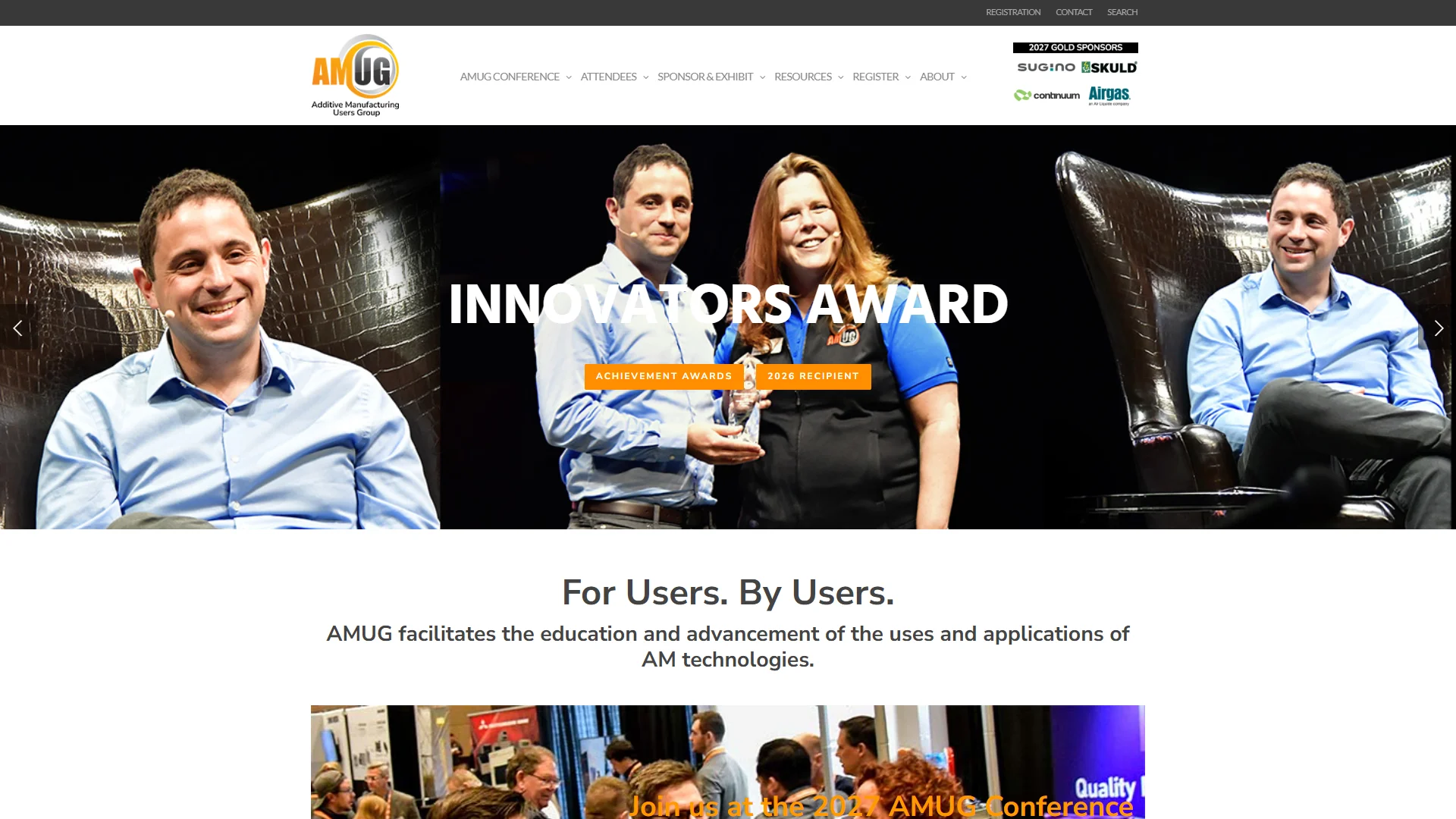
Overview: Additive Manufacturing Users Group is not presented in the supplied dossier as a printer manufacturer. It is associated with the AMUG Conference and professional knowledge exchange. The official source material describes technical sessions, hands-on workshops, keynotes, and the Innovators Showcase.
Products and scope: The available evidence does not identify a printer product line, material portfolio, or manufacturing service. Its principal offering for this comparison is access to technical programming and an industry community. The dossier also references conference tracks and submission information, indicating a structured program for technical content.
Pros / key features:
- More than 100 technical sessions are identified in the supplied evidence.
- Hands-on and interactive workshops are part of the conference format.
- Keynotes and an Innovators Showcase broaden the learning program.
- Scholarships are documented for one student and one educator.
Use cases / best for: AMUG is best for engineers, operators, researchers, educators, and managers who need practical additive-manufacturing education or peer knowledge. It can be valuable before a major technology purchase because users can learn about implementation issues, applications, and production experience. It should not be evaluated as a direct alternative to a printer manufacturer or contract manufacturer.
5. 3D Printers Depot
Overview: 3D Printers Depot describes itself as a supplier of 3D printers, 3D scanners, filaments, and accessories for professional and in-home use. Its business model is an online shop that brings together products from established equipment manufacturers. This makes it a purchasing and comparison channel rather than a single proprietary printer brand.
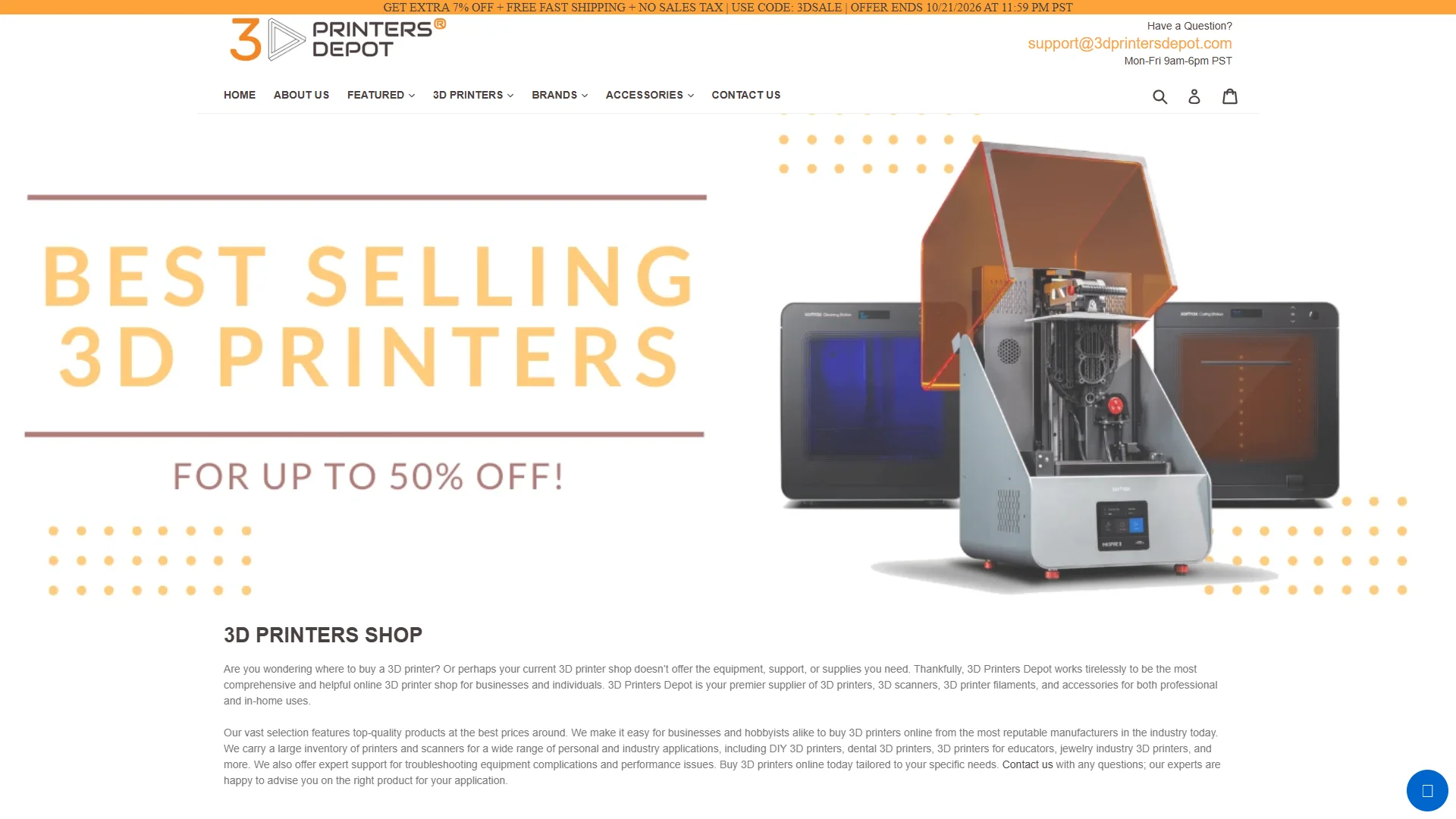
Products and scope: The documented categories include business 3D printers, office 3D printers, scanners, filament, and accessories. The site emphasizes product variety and online purchasing. The supplied research does not establish a company founding date, location, private-label manufacturing capability, or specific service region.
Pros / key features:
- One online source for printers, scanners, filament, and accessories.
- Coverage of both professional and home-use equipment.
- Business and office printer categories are explicitly identified.
- Useful for comparing products from multiple manufacturers.
Use cases / best for: 3D Printers Depot is best for buyers who want to compare equipment and supplies through an online distributor. It may be practical for offices, hobbyists, schools, and businesses that need a complete purchasing channel. Buyers should verify warranty responsibility, installation, training, replacement-part availability, shipping terms, and technical support before selecting a high-value system.
6. Rapid.Tech 3D
Overview: Rapid.Tech 3D is represented in the supplied research as an additive-manufacturing exhibition and conference platform. The available evidence refers to keynotes and presentations covering technologies, materials, and industrial applications of additive manufacturing.
Products and scope: The dossier does not identify a proprietary printer, materials portfolio, contract-production service, or manufacturing plant. It does identify an event format built around professional communication, including communication tables intended to encourage direct technical conversations rather than relying only on conventional exhibition stands.
Pros / key features:
- Focuses on additive-manufacturing technologies and industrial applications.
- Includes presentations addressing materials and technical subjects.
- Communication-table format is designed to support direct specialist discussions.
- Useful for market intelligence and supplier discovery.
Use cases / best for: Rapid.Tech 3D is best for industry professionals seeking technical briefings, application knowledge, and supplier conversations. It can help organizations build a shortlist or understand emerging processes. Because the supplied evidence does not document a proprietary equipment range, it should not be compared with a printer manufacturer on machine specifications alone.
7. A3D Manufacturing
Overview: A3D Manufacturing operates as a hybrid manufacturing provider. Its documented model combines in-house additive manufacturing with traditional processes coordinated through a vetted supplier network. The stated aim is to provide one accountable partner from prototype through full production.
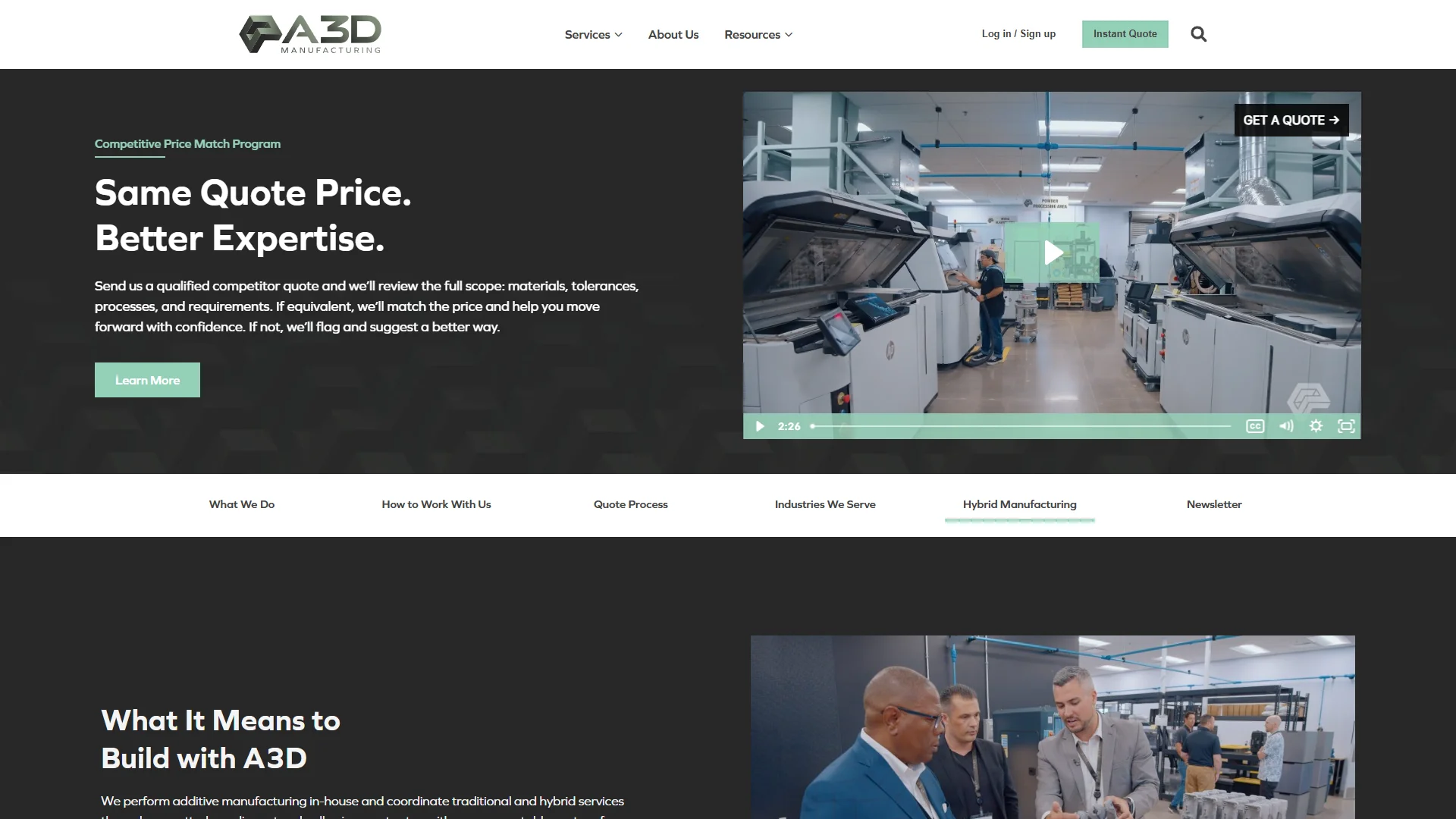
Products, processes, and materials: A3D’s documented services include 3D printing, CNC machining, injection molding, and urethane casting. The research describes support for rapid prototyping, small-batch manufacturing, burst capacity, jigs, fixtures, repeat orders, multi-part assemblies, complex parts, and special materials or finishes. Customers can upload CAD files and request custom pricing or tailored recommendations.
Pros / key features:
- Combines additive manufacturing with several traditional production methods.
- Supports workflows from prototype to production.
- Offers file review, manufacturing recommendations, and custom quoting.
- Supports file formats including STL, STEP, IGES, and SLDPRT.
- Documents ISO 9001:2015 and AS9100:2016 certification and ITAR registration.
- Provides stated support for aerospace, medical, electric-vehicle, defense, and aftermarket applications.
Use cases / best for: A3D Manufacturing is best for organizations that need custom parts rather than a printer purchase. It is particularly relevant to teams moving between prototyping, small-batch production, production-ready components, and traditional manufacturing. Regulated or defense-related projects should still confirm the exact scope of applicable controls, documentation, materials, and customer responsibilities.
8. Stratasys
Overview: Stratasys offers a broad additive-manufacturing portfolio spanning five identified technologies, from smaller office-oriented systems to large industrial equipment. The supplied research describes applications across aerospace, automotive, healthcare, and digital dentistry, with materials and software forming part of the wider solution.
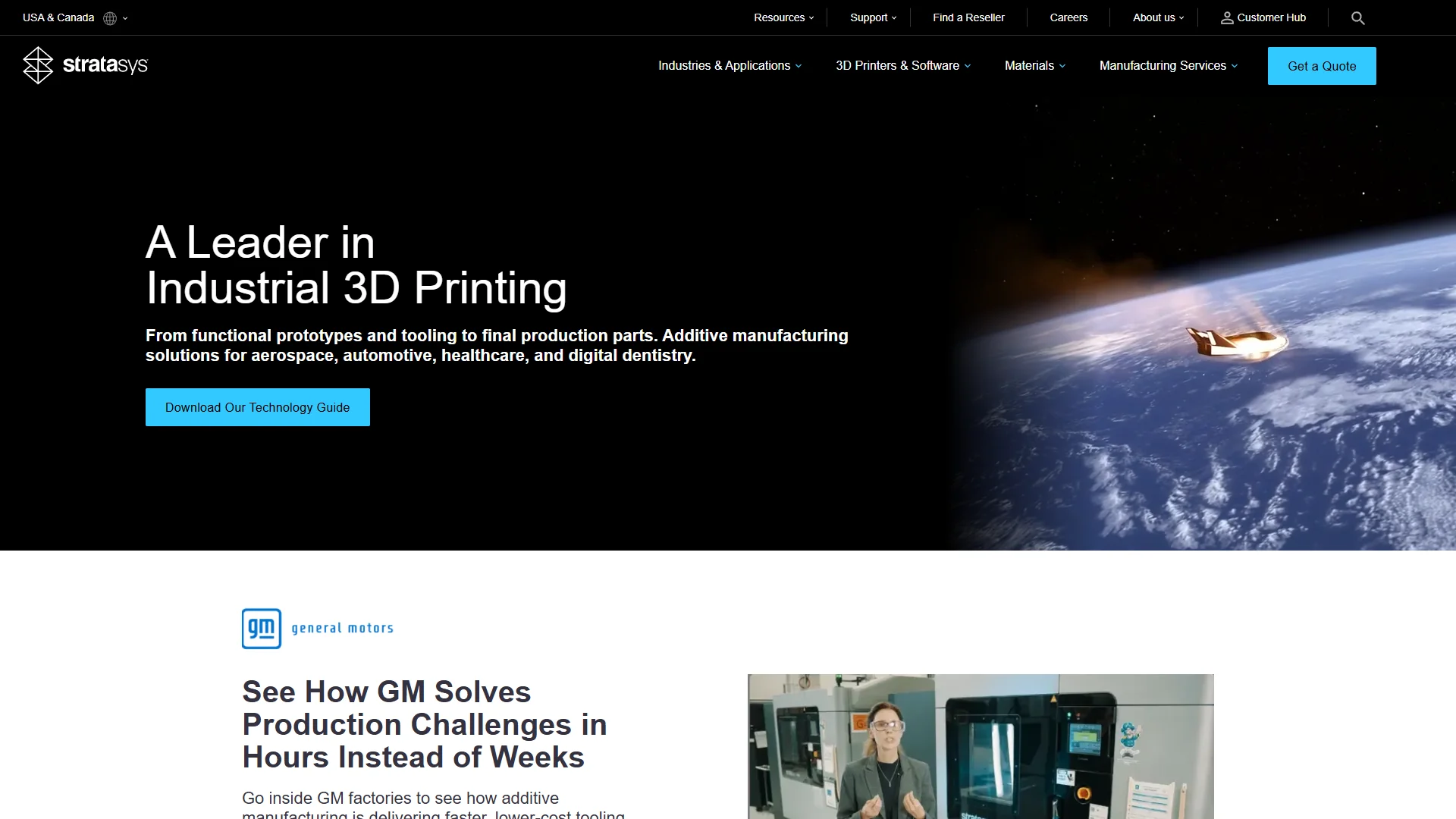
Products and materials: The portfolio includes thermoplastics for functional prototypes, tooling, and production parts; photopolymers cured with ultraviolet light in stereolithography; silicone printing for performance-grade parts without molds; and powdered thermoplastics used in selective absorption fusion. The research also references P3 digital light processing and a broad range of polymers with different characteristics for different design requirements.
Pros / key features:
- Multiple additive technologies cover office, prototyping, tooling, and industrial production needs.
- Broad material selection includes thermoplastics, photopolymers, silicone, and powdered thermoplastics.
- Applications include aerospace, automotive, healthcare, and digital dentistry.
- High-resolution systems are described for detailed prototypes, concept models, and low-volume production.
- Industrial case material references production tooling and supply-chain benefits.
- An ecosystem of software partners expands workflow options.
Use cases / best for: Stratasys is best for organizations seeking a wide industrial portfolio and a technology matched to a specific application. It can suit prototype validation, custom tooling, production parts, medical and dental workflows, and demanding engineering environments. Buyers should select the process only after comparing resolution, mechanical performance, production volume, post-processing, software, material cost, and qualification needs.
How to Choose Among 3D Printing Manufacturers
1. Define the output before the machine
Start with the part’s function, dimensions, tolerances, surface requirements, expected quantity, and service life. A prototype, production fixture, dental component, and end-use industrial part may require entirely different technologies.
2. Match the process to the material
Material compatibility affects strength, temperature resistance, flexibility, chemical resistance, appearance, and post-processing. Request a current material matrix and verify whether the material is approved for the intended application rather than relying on a general technology label.
3. Compare total cost of ownership
Purchase price is only one part of the calculation. Include software, consumables, maintenance, service contracts, training, installation, post-processing, facility requirements, labor, rejected parts, and energy use.
4. Examine production economics
For recurring production, compare throughput, nesting or batch efficiency, changeover time, automation, repeatability, and cost per acceptable part. For prototypes, flexibility and short setup time may matter more than maximum throughput.
5. Verify quality and compliance
Ask for dimensional data, process controls, inspection methods, traceability, and relevant certifications. Regulated sectors should confirm whether the supplier’s documented controls cover the specific product, facility, material, and production location involved.
6. Evaluate support and supply continuity
Determine who provides installation, training, troubleshooting, spare parts, software updates, and warranty support. Also check material availability, regional support, expected lead times, and the consequences of a system being unavailable.
7. Distinguish manufacturers from platforms and service providers
Exhibitions, user groups, distributors, contract manufacturers, and equipment manufacturers serve different roles. An event may improve market knowledge, a distributor may simplify purchasing, and a service provider may eliminate the need to own equipment. The correct option depends on whether the goal is learning, buying, outsourcing, or operating a production system.
Final Verdict
TCT Asia ranks first as a broad discovery and comparison platform for additive-manufacturing technologies and suppliers. LulzBot is the more focused option for professional and educational printer users seeking documented reliability and repeatability in the TAZ range. HP is aimed at industrial additive manufacturing and material development, while Stratasys offers one of the broadest documented technology and material portfolios in this selection.
A3D Manufacturing is the strongest fit for outsourced custom production and hybrid manufacturing. 3D Printers Depot is relevant to buyers who prefer an online source for printers, scanners, filaments, and accessories. Additive Manufacturing Users Group and Rapid.Tech 3D are best treated as education, networking, and industry-information resources rather than direct printer alternatives. The final choice should follow the application, material, production volume, compliance obligations, and support model rather than brand recognition alone.
FAQs
Which option is best for comparing several additive-manufacturing technologies?
TCT Asia is the most suitable starting point in this list because it is presented as an industry platform for discovering technologies, materials, applications, and suppliers. A specific purchase should still be validated through the selected manufacturer’s technical documents and demonstrations.
Are all eight entries printer manufacturers?
No. The list includes printer manufacturers, a hybrid manufacturing provider, an online distributor, and industry education or exhibition platforms. Their roles differ, so they should not be judged by identical criteria.
What information should be requested before purchasing a 3D printer?
Request build volume, process specifications, supported materials, resolution, repeatability data, throughput, software requirements, installation needs, maintenance terms, warranty coverage, training, service response, consumable costs, and sample parts produced under conditions similar to the intended application.