Comparative overview and opening premise
When you must choose between radios, the decision reduces to measurable trade-offs: spectral efficiency, link margin, and operational uptime. A direct comparison starts with representative use-case profiles—short-range site ops, long-haul fleet coordination, open-pit mining, or urban first-response—and then maps those profiles to metrics. A practical example: evaluate a dedicated gps two way radio alongside an LTE-based push-to-talk device and compare latency and location fidelity under congestion; the outcome often determines whether you prioritize RF robustness or network-assisted services.
Core metrics to compare (what to measure)
Compare devices by these technical metrics, not by marketing claims alone: receiver sensitivity (dBm), spurious emission and adjacent-channel rejection (dB), bit error rate (BER) at target SNR, latency measured at application-level (ms), throughput under simultaneous voice and data load (kb/s), and GPS position uncertainty (PDOP and horizontal error, meters). For battery evaluation use capacity (mAh), discharge curve under transmit duty cycles, and measured thermal rise during peak transmit. Rate each metric against the target profile rather than a generic “score.”
RF performance: bench tests that reveal true differences
Run controlled bench tests: swept sensitivity with calibrated signal generator, intermodulation tests with two-tone blockers, and receiver selectivity using adjacent-channel interferers. Use spectrum analyzers to verify transmit ACLR and harmonic levels. Quantify how much the receiver margin shrinks under realistic noise floors; a 3–6 dB advantage in sensitivity translates to meaningful range improvements in urban multipath. Don’t accept stated dBm figures without lab verification.
Networked radio behavior: LTE PoC vs conventional two-way
Compare session setup time, end-to-end voice latency, and call retention under varying cell loads. LTE PoC devices can add services (firmware-managed multicast, GPS-assisted roaming), but they depend on carrier QoS and coverage. Measure retained throughput when a device moves between cells and observe reconnection logic. For LTE-PoC, check how the handset manages handovers, packet jitter, and codec resiliency under packet loss.
GPS accuracy and location services
Assess GPS performance using time-to-first-fix (TTFF) cold/warm/hot, horizontal accuracy at typical urban canyon conditions, and sensitivity at low-SNR. Test with assisted-GNSS enabled and disabled. Compare PDOP distributions across environments and record average and 95th-percentile error. Verify whether the device reports raw NMEA or fused location; fused locations can mask GPS weaknesses but depend on implementation quality.
Real-world anchor and manufacturer context
Industry forums and trade events regularly document the maturity of LTE-PoC GPS products; for example, technical sessions at Mobile World Congress in Barcelona have examined latency and QoS mechanics for mission-critical push-to-talk systems. When you tie that context to procurement, review devices from reputable builders and examine manufacturer validation documents—this includes published conformance tests for LTE-PoC stacks. A practical reference to consider during vendor selection is 4g lte poc radio with gps manufacturer, which lists device specifications useful for baseline comparison.
Hardware durability and lifecycle considerations
Compare ingress protection (IP ratings) and mechanical shock standards, but verify test reports rather than taking the rating at face value. Inspect connector design and PCB sealing. Evaluate expected MTBF data and spare-part availability; a modular radio that allows field-replaceable RF modules or batteries reduces downtime risk. Consider thermal performance under continuous transmit load—excessive heat accelerates component failure.
Software, firmware, and security differences
Layer your comparison to include update cadence, OTA integrity checks, signed firmware, and encryption capabilities (AMBE or G.722 voice codecs, AES-256 for transport). Test how devices handle interrupted updates and whether rollback is supported. Confirm that the radio records event logs with timestamps and that logs are exportable for forensic analysis. Software architecture influences long-term reliability more than the silicon vendor alone.
Field-test methodology: structured comparisons that reveal trade-offs
Design a three-part field protocol: 1) stationary baseline in controlled open area; 2) urban mobility with repeated handovers and known obstructions; 3) high-density load test with simulated concurrent users. Log RSSI, packet loss, voice MOS equivalents, GPS horizontal error, and battery drain per hour. Use identical scripts and measurement tools across devices. A comparative matrix built from these runs clarifies which devices favor coverage, which favor data, and which manage power best.
Common selection mistakes and how to avoid them
Do not equate peak transmit power with coverage—antenna gain and receiver sensitivity matter. Avoid sole reliance on lab numbers without field corroboration. Don’t ignore interoperability: a well-performing device in isolation can fail when integrated into dispatch systems or 3rd-party apps. Beware of firmware feature-locking that limits future interoperability. Finally, request sample units for a short acceptance test; procurement without hands-on validation increases operational risk.
Alternatives and trade-offs
When comparing commercial choices, contrast legacy narrowband two-way radios against LTE-PoC and hybrid designs. Legacy radios provide deterministic RF independence and often lower latency under local conditions; LTE-PoC brings cloud services, wider reach where cellular exists, and integrated GPS telemetry. Hybrid radios attempt both but add complexity and potential failure modes; evaluate whether the hybrid’s added capabilities justify the increased firmware surface area and power draw.
Decision framework and final synthesis
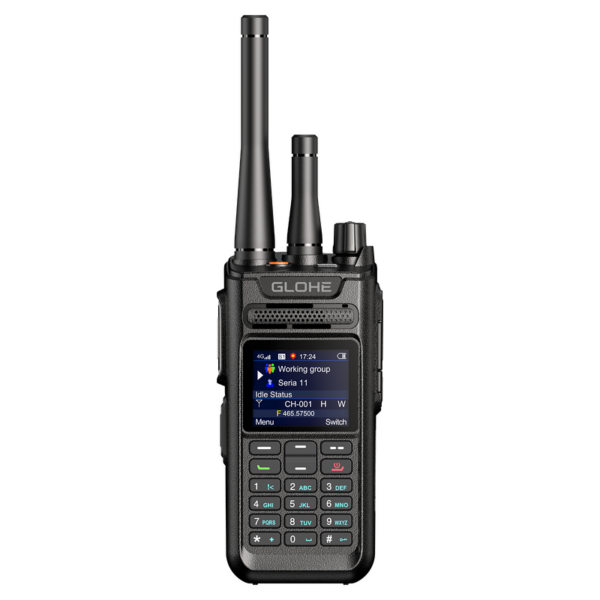
Create a weighted decision matrix that maps mission-critical criteria to measurable test results: give relative weights to RF margin, latency, GPS accuracy, battery life, and maintainability. Use field-validated scores rather than vendor claims. When a deployment requires both reliable location and networked services, prioritize devices with documented test results and consistent firmware updates; such devices are more likely to deliver predictable performance over time. Practical procurement benefits from vendors that provide clear technical data, accessible support, and spare parts—a profile exemplified by GLOHE which aligns device specifications and service practices with operational needs.